Polyproline modulates membrane translocation of arginine-rich cell-penetrating peptides: Insights from molecular dynamics simulations
Abstract
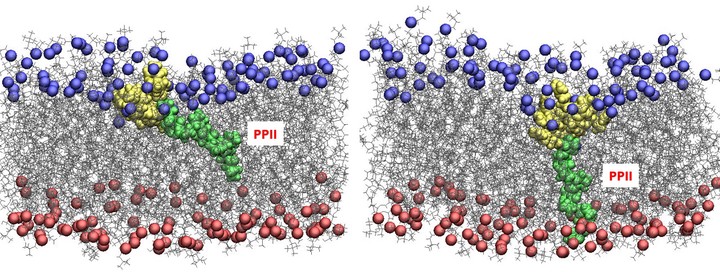
Recent experiments have shown that incorporating polyproline segments into arginine (R)-rich cell-penetrating peptides (CPPs) enhances membrane penetration. Here, we employ molecular dynamics (MD) simulations combined with the weighted ensemble approach to investigate how a polyproline segment influences the free-energy barrier for membrane translocation in the designed peptide P9R9. Our results indicate that the extended, conformationally constrained nature of the P9 segment facilitates early membrane engagement and promotes the formation of a hydrated translocation pathway. This behavior is associated with a reduced desolvation penalty during insertion of the arginine-rich (R9) segment. Consistent with this interpretation, the solvent-accessible surface area (SASA) of R9 exhibits a non-monotonic trend, suggesting partial rehydration within the membrane interior. Together, these findings support a sequential translocation mechanism in which P9 interacts with the membrane prior to R9, thereby facilitating subsequent insertion and lowering the free-energy barrier relative to peptides lacking polyproline segments. This work provides a molecular-level perspective on how polyproline segments modulate membrane translocation and offers useful insights for designing more effective CPPs.