Ab initio insights into diluent-driven interfacial reactivity in locally concentrated ionic liquid electrolytes at lithium metal
Abstract
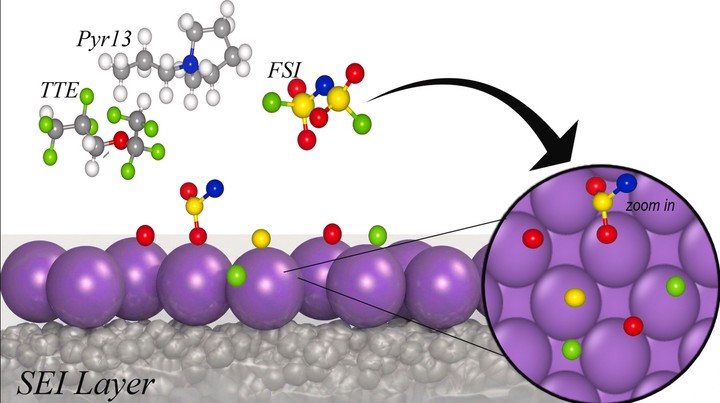
Locally concentrated ionic liquid electrolytes (LCILEs), created by incorporating non-coordinating diluents, have emerged as promising electrolytes for lithium metal batteries because of their ability to form robust LiF-rich solid–electrolyte interphases (SEIs). Despite their growing importance, the molecular-level role of diluents in governing interfacial structure and reactivity remains poorly understood. Here, we systematically investigate how diluent concentration modulates the interfacial decomposition of LiFSI salt in anion-rich Pyr13FSI electrolytes on the Li(001) surface using density functional theory (DFT) and ab initio molecular dynamics (AIMD), complemented by Raman spectroscopy, time-of-flight secondary ion mass spectrometry (ToF-SIMS), and X-ray photoelectron spectroscopy (XPS). We show that increasing the TTE concentration weakens electrolyte adsorption at the Li(001) interface, suppresses interfacial charge transfer, and induces the reorientation of FSI− from bidentate to ambidentate coordination as Li–F interactions diminish. FSI− decomposition produces LiF, Li2O, and Li2S through pathways involving a persistent NSO2 intermediate, while excess TTE delays decomposition and modifies both the reaction energetics and decomposition mechanisms. Bader charge analysis further elucidates the sequence of decomposition events. Consistent with these predictions, ToF-SIMS and XPS reveal enhanced F− and LiF2− signatures at intermediate TTE concentrations, confirming more favorable formation of a LiF-rich SEI. Overall, our findings establish diluent concentration as a key parameter governing interfacial reactivity, anion coordination chemistry, and SEI evolution, providing molecular-level design principles for next-generation lithium metal batteries.